
Revision Spine Surgery: Causes, Treatment Options and Recovery After Failed Back Surgery
Revision Spine Surgery: Advanced Treatment for Persistent Pain After Previous Spine Surgery
Spine surgery is often performed to relieve nerve compression, stabilize the spinal column, correct deformities, or improve mobility. Although many patients experience meaningful improvement following their initial procedure, some continue to experience pain, develop new symptoms, or face complications that require further medical evaluation.
In certain cases, revision spine surgery may be recommended to address problems related to a previous spinal operation.
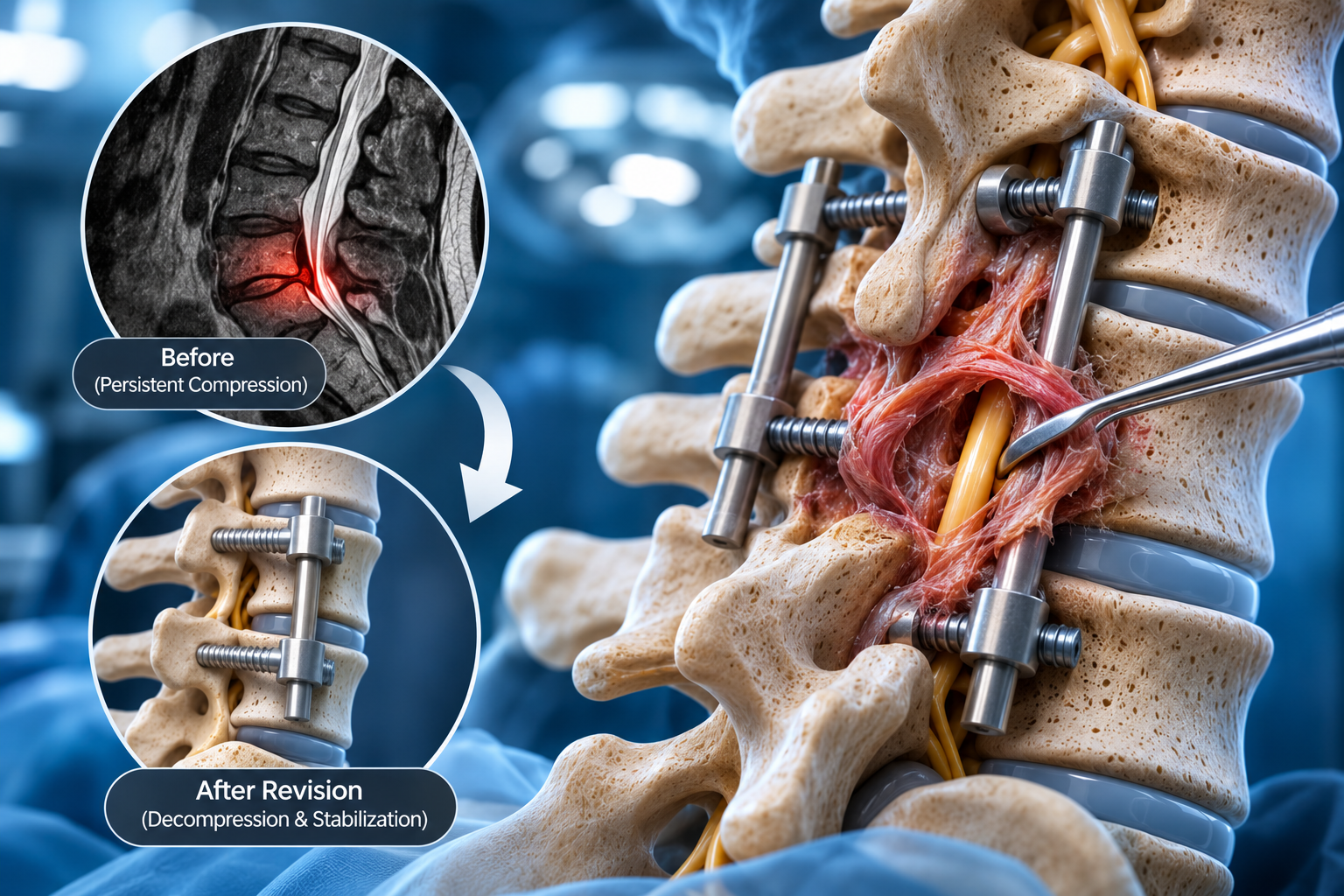
Revision spine surgery is a specialized procedure designed to correct structural problems, restore spinal stability, relieve nerve compression, or manage complications following earlier spinal treatment.
At Dr. Firas Husban’s practice, revision surgery is among the advanced spine services available for patients with complex spinal conditions.
What Is Revision Spine Surgery?
Revision spine surgery refers to a surgical procedure performed on an area of the spine that has previously undergone surgery.
Unlike an initial spinal operation, revision surgery can involve additional challenges because of scar tissue, changes in spinal anatomy, existing implants, altered bone structures, and previous surgical modifications.
The objective is not simply to repeat the original operation. Instead, the surgeon must identify the specific cause of the patient’s ongoing or new symptoms and determine whether another surgical procedure can effectively address the problem.
Revision procedures may involve:
- Removing or replacing spinal implants
- Correcting spinal instability
- Revising a previous spinal fusion
- Relieving persistent nerve compression
- Addressing recurrent disc herniation
- Correcting spinal deformities
- Treating complications associated with previous surgery
Not every patient with persistent pain after surgery requires another operation. A detailed evaluation is essential before considering revision surgery.
Why Might a Previous Spine Surgery Fail to Provide Lasting Relief?
There are several reasons why a patient may continue experiencing symptoms after spinal surgery.
Some problems are directly related to the original spinal condition, while others may develop months or years after the procedure.
1. Recurrent Disc Herniation
A herniated disc can sometimes recur after surgical treatment.
When disc material again compresses a nearby nerve, the patient may experience symptoms similar to those that occurred before the initial operation.
These may include lower back pain, radiating leg pain, numbness, or weakness.
2. Incomplete Nerve Decompression
In some cases, pressure on the spinal nerves may remain after the original operation.
Persistent compression can contribute to ongoing neurological symptoms.
However, continued pain does not automatically mean that the original surgery was unsuccessful. Nerves may require time to recover, and some neurological symptoms can persist despite adequate decompression.
3. Failed Spinal Fusion or Pseudarthrosis
Spinal fusion is intended to create a stable connection between two or more vertebrae.
If the bones do not fuse successfully, a condition known as pseudarthrosis or nonunion may develop.
This can sometimes result in persistent pain, abnormal movement, or mechanical instability.
4. Adjacent Segment Disease
After spinal fusion, the segments above or below the fused area may develop degenerative changes over time.
In some patients, these changes can become symptomatic and cause nerve compression, pain, or instability.
Not all adjacent-level degeneration causes symptoms or requires surgery.
5. Implant-Related Complications
Spinal fixation procedures may involve screws, rods, cages, or other implants.
Potential complications include implant loosening, breakage, displacement, or problems related to inadequate fusion.
6. Spinal Imbalance or Deformity
Changes in spinal alignment may contribute to pain, fatigue, or difficulty maintaining an upright posture.
In selected cases, revision surgery may be considered to improve spinal alignment and stability.
Common Symptoms That May Require Further Evaluation
Patients who have undergone previous spine surgery should seek medical assessment if they develop persistent or worsening symptoms.
Possible warning signs include:
- Persistent lower back or neck pain
- Pain extending into the arms or legs
- Numbness or tingling
- Muscle weakness
- Difficulty walking or standing
- Reduced mobility
- Increasing spinal deformity
- New neurological symptoms
- Pain that significantly affects daily activities
Sudden or progressive weakness, new loss of bladder or bowel control, or numbness around the groin requires urgent medical evaluation.
These symptoms may indicate serious nerve compression or another medical emergency.
How Are Problems After Previous Spine Surgery Diagnosed?
Successful revision treatment begins with identifying the cause of the patient’s symptoms.
The diagnostic process may involve reviewing the original diagnosis, previous surgical records, current symptoms, and imaging results.
Medical History and Physical Examination
The spine specialist evaluates the patient’s symptoms and neurological function.
Important information includes:
- Type of previous surgery
- Date of the original procedure
- Symptoms before surgery
- Improvement following surgery
- When symptoms returned
- Previous complications
- Current medications and medical conditions
Magnetic Resonance Imaging (MRI)
MRI can help evaluate the spinal cord, nerve roots, discs, soft tissues, and potential areas of nerve compression.
Depending on the patient’s surgical history, contrast-enhanced MRI may be useful in distinguishing postoperative scar tissue from recurrent disc herniation.
Computed Tomography (CT)
CT scans provide detailed information about spinal bones and existing surgical implants.
They may help evaluate fusion status, implant positioning, and structural abnormalities.
X-Rays
Standing or dynamic X-rays may help assess spinal alignment, stability, and abnormal movement between vertebrae.
Additional Tests
Depending on the case, the physician may recommend laboratory investigations, nerve studies, or other diagnostic procedures.
The choice of tests depends on the patient’s symptoms and suspected diagnosis.
Does Persistent Pain After Back Surgery Always Require Revision Surgery?
No.
Persistent pain following spinal surgery does not automatically mean that another operation is necessary.
Some patients may benefit from non-surgical treatment, including:
- Physical therapy
- Pain management
- Appropriate medication
- Rehabilitation
- Activity modification
- Targeted injections in selected cases
- Treatment of other contributing conditions
The most appropriate treatment depends on the cause of the symptoms.
Revision surgery is generally considered when there is a clearly identified structural or neurological problem that surgery is reasonably expected to improve.
When Is Revision Spine Surgery Recommended?
Revision surgery may be considered when a patient has a condition such as:
- Recurrent disc herniation with significant symptoms
- Persistent or recurrent nerve compression
- Symptomatic spinal instability
- Failed spinal fusion
- Certain implant-related complications
- Progressive spinal deformity
- Symptomatic adjacent segment disease
- Certain postoperative complications
The decision must balance the expected benefits of surgery against the potential risks.
What Happens During Revision Spine Surgery?
Revision spine surgery is highly individualized.
The procedure depends on the original operation, the current spinal condition, and the specific problem requiring correction.
Step 1: Preoperative Planning
The surgeon carefully reviews imaging studies, previous surgical reports, existing implants, and spinal alignment.
Step 2: Accessing the Affected Spinal Area
The surgeon selects an appropriate approach to reach the affected region.
In some cases, a different surgical corridor may help avoid previously operated tissues.
Step 3: Addressing the Underlying Problem
Depending on the diagnosis, the surgeon may remove compressive tissue, revise implants, decompress nerves, or correct spinal alignment.
Step 4: Restoring Spinal Stability
If instability is present, additional fixation or fusion may be necessary.
Step 5: Postoperative Monitoring
After surgery, the patient is monitored for neurological function, pain control, wound healing, and other potential complications.
Minimally Invasive Revision Spine Surgery
Advances in surgical technology have expanded the options available for selected revision procedures.
Minimally invasive techniques aim to achieve the required surgical objective while reducing unnecessary tissue disruption.
Potential advantages in appropriately selected patients may include:
- Smaller incisions
- Less muscle disruption
- Reduced blood loss
- Reduced postoperative discomfort
- Earlier mobilization
- Potentially shorter hospital stays
However, revision procedures can be more complex than primary surgery.
Scar tissue, previous implants, spinal deformity, and altered anatomy may make a minimally invasive approach unsuitable in some cases.
The safest technique depends on the individual patient’s condition.
What Are the Risks of Revision Spine Surgery?
Revision spine surgery may carry greater technical complexity than an initial spinal operation.
Potential complications include:
- Infection
- Bleeding
- Nerve injury
- Dural tears and cerebrospinal fluid leakage
- Persistent or recurrent pain
- Failure of spinal fusion
- Implant-related complications
- Blood clots
- Risks associated with anesthesia
- Need for further surgery
The likelihood of complications varies according to the patient’s health, previous procedures, spinal anatomy, and complexity of the planned operation.
Patients should discuss the expected benefits, limitations, and risks with their surgeon before proceeding.
Recovery After Revision Spine Surgery
Recovery depends on the type and extent of the procedure.
A limited revision decompression may have a different recovery timeline from a complex reconstruction involving several spinal levels.
Factors affecting recovery include:
- Number of spinal levels treated
- Type of previous surgery
- Extent of revision
- Whether spinal fusion is required
- Neurological condition
- Age and overall health
- Bone quality
- Rehabilitation requirements
Some patients may begin walking relatively soon after surgery, while others require a longer period of recovery.
When fusion is performed, bone healing can take several months.
Following postoperative instructions, attending follow-up appointments, and participating in rehabilitation when recommended are important parts of recovery.
Revision Spine Surgery With Dr. Firas Husban
Dr. Firas Husban is a consultant orthopedic surgeon specializing in spine surgery, with more than 28 years of experience treating complex spinal conditions.
His practice includes advanced spinal procedures, minimally invasive techniques, spinal fixation, deformity correction, and revision surgery.
The clinic’s published patient cases include individuals who previously underwent spinal operations and later required further evaluation or corrective treatment.
These cases demonstrate the importance of detailed surgical planning when managing patients with complex postoperative spinal problems.
Treatment decisions are based on the patient’s current diagnosis, neurological condition, spinal stability, and individual treatment needs.
Frequently Asked Questions About Revision Spine Surgery
Is revision spine surgery more difficult than the first operation?
Revision surgery can be more technically challenging because of scar tissue, existing implants, altered anatomy, or previous fusion.
However, the complexity depends on the type of revision required.
Can spinal fusion be corrected if it does not heal properly?
In selected cases, a failed spinal fusion may be treated with revision surgery.
The treatment may involve additional bone grafting, replacement of implants, or changes to the fixation strategy.
Can a herniated disc return after surgery?
Yes. Disc herniation can recur after surgical treatment, although recurrence does not necessarily mean that another operation is required.
Can revision surgery relieve chronic back pain?
Revision surgery may improve pain when a correctable structural problem is responsible for the symptoms.
However, pain relief cannot be guaranteed, and not all chronic back pain responds to surgery.
How long does recovery take?
Recovery varies depending on the extent of the operation, whether fusion is required, and the patient’s overall health.
Is minimally invasive revision surgery possible?
Yes, in selected patients. However, some complex cases require a more extensive surgical approach.
When Should You Consult a Revision Spine Specialist?
If you previously underwent spine surgery and are now experiencing persistent pain, recurrent symptoms, weakness, numbness, or difficulty walking, a specialist evaluation may help identify the cause.
The purpose of the consultation is to determine whether symptoms are related to the previous procedure, a new spinal condition, or another medical problem.
Not every patient needs another operation.
A careful diagnosis can help identify whether conservative treatment or revision surgery offers the most appropriate path forward.
Schedule a Consultation With Dr. Firas Husban
Persistent symptoms after spine surgery can significantly affect mobility, comfort, and quality of life.
A comprehensive evaluation can help determine the cause of the symptoms and whether corrective treatment may be beneficial.
Dr. Firas Husban provides specialized assessment and advanced surgical treatment options for complex spinal conditions, including revision spine surgery.
Medical Disclaimer: This article is intended for educational purposes only and does not replace a medical examination, diagnosis, or individualized treatment recommendation from a qualified physician.
Post Tags :
- adjacent segment disease
- complex spine surgery
- corrective spine surgery
- Dr Firas Husban spine surgery
- Dr. Firas Husban
- failed back surgery syndrome
- failed back surgery treatment
- failed spinal fusion treatment
- minimally invasive revision spine surgery
- persistent pain after back surgery
- pseudarthrosis treatment
- recurrent disc herniation
- revision spinal surgery
- revision spine surgery
- revision spine surgery Jordan
- spinal fusion revision
- spinal hardware complications
- spine implant revision
- spine specialist Jordan
- spine surgeon Amman
- أسباب استمرار الألم بعد عملية الديسك
- إعادة جراحة العمود الفقري
- إعادة جراحة العمود الفقري في الأردن
- إعادة عملية تثبيت الفقرات
- استشاري جراحة العمود الفقري في الأردن
- الدكتور فراس الحسبان
- تصحيح عمليات العمود الفقري السابقة
- جراح العمود الفقري في عمان
- جراحة إعادة تثبيت الفقرات
- جراحة إعادة تصحيح العمود الفقري
- جراحة العمود الفقري التصحيحية
- جراحة العمود الفقري بالتدخل المحدود
- علاج الألم بعد عملية الظهر
- علاج تآكل الفقرات المجاورة
- علاج ضغط الأعصاب بعد العملية
- علاج عدم التحام الفقرات
- علاج عودة الانزلاق الغضروفي
- علاج فشل تثبيت الفقرات
- علاج فشل عمليات الظهر
- علاج مضاعفات تثبيت الفقرات

