

Spinal Tumors: Symptoms, Diagnosis, Treatment and Modern Surgical Options
Spinal Tumors: Understanding Symptoms, Diagnosis and Advanced Treatment Options
What Are Spinal Tumors?
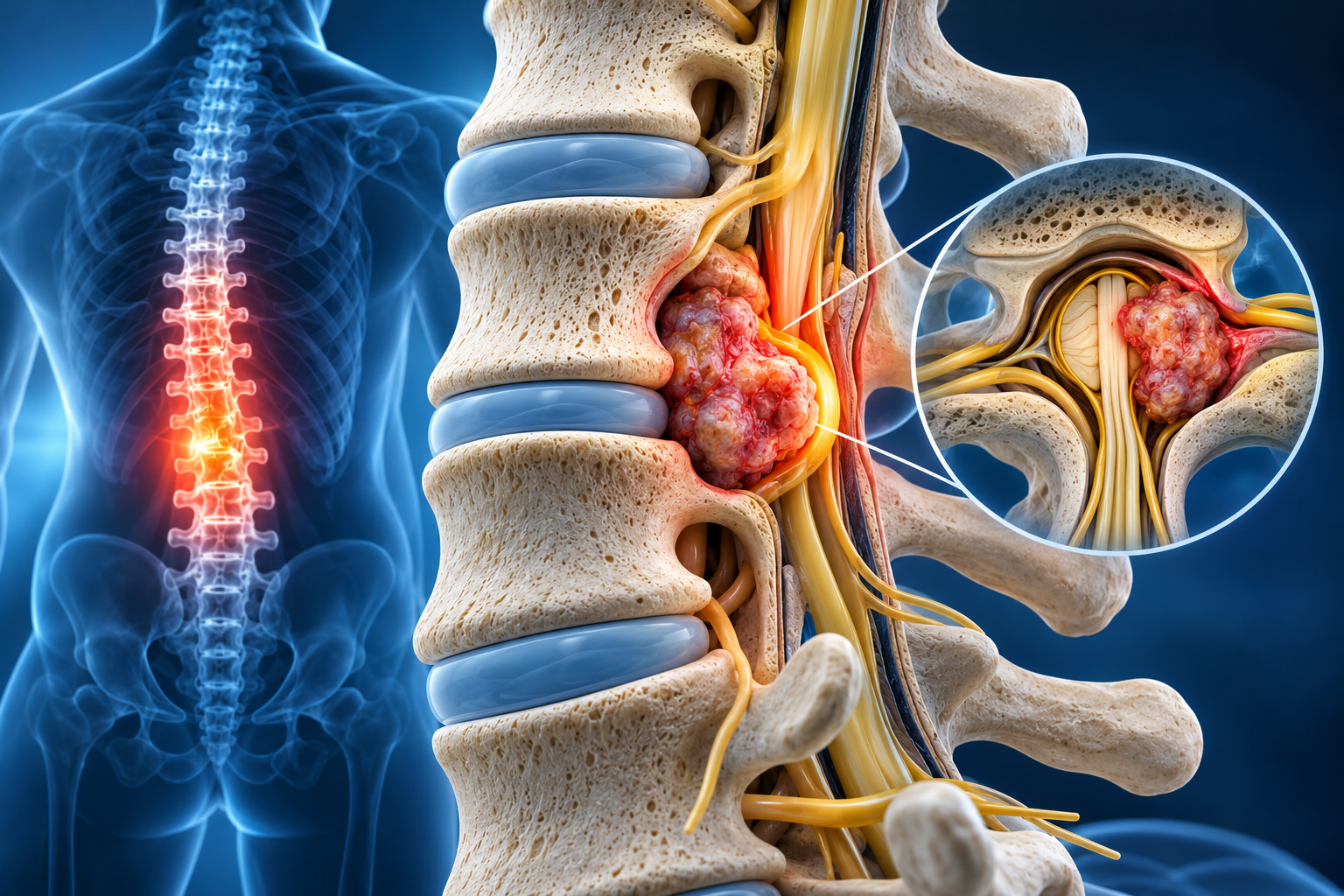
Spinal tumors are abnormal growths of cells that develop within or around the spinal column. They can affect the vertebrae, spinal cord, nerve roots, or surrounding tissues.
Some spinal tumors are benign, meaning they are not cancerous, while others are malignant and may require more complex treatment.
Spinal tumors can occur at different levels of the spine, including the cervical, thoracic, and lumbar regions. Their symptoms and treatment depend largely on their location, size, type, and relationship to the spinal cord and nerves.
Because the spinal canal contains the spinal cord and important nerve structures, even a relatively small tumor can sometimes cause significant neurological symptoms if it places pressure on these structures.
What Causes Spinal Tumors?
In many cases, the exact cause of a spinal tumor is not known.
Spinal tumors can develop as primary tumors that originate within the spine or spinal structures, or as secondary tumors that have spread from another part of the body.
Primary spinal tumors are relatively uncommon.
Metastatic spinal tumors, on the other hand, occur when cancer from another part of the body spreads to the spine. These tumors can affect the vertebrae and may weaken the bone, potentially leading to spinal instability or fracture.
Types of Spinal Tumors
Spinal tumors can be classified according to where they develop.
Vertebral Tumors
These tumors develop in the bones of the spine.
They may weaken the vertebrae and cause:
- Persistent back pain
- Vertebral collapse
- Spinal deformity
- Fractures
- Nerve or spinal cord compression
Intradural Tumors
These tumors develop inside the protective covering surrounding the spinal cord.
Some may arise from the nerve roots or other structures within the spinal canal.
Intramedullary Tumors
These tumors develop within the spinal cord itself.
Because of their location, treatment can require highly specialized surgical planning.
Metastatic Spinal Tumors
These occur when cancer spreads from another part of the body to the spine.
Metastatic disease can affect spinal stability and may cause significant pain or neurological symptoms.
What Are the Symptoms of a Spinal Tumor?
Symptoms vary depending on the location and size of the tumor.
Persistent back pain is one of the most common symptoms, but spinal tumors can cause a wide range of neurological and structural problems.
Possible symptoms include:
- Persistent or worsening back pain
- Neck pain
- Pain that becomes worse at night
- Pain radiating into the arms or legs
- Numbness or tingling
- Muscle weakness
- Difficulty walking
- Balance problems
- Changes in coordination
- Loss of sensation
- Changes in bladder or bowel function
A spinal tumor does not necessarily cause all of these symptoms.
Many common spinal conditions can produce similar symptoms, which is why proper medical evaluation is essential.
When Should Back Pain Be Evaluated?
Most cases of back pain are not caused by tumors.
However, persistent or unusual back pain should be evaluated by a physician, particularly when it is accompanied by neurological symptoms.
Medical evaluation is especially important when back pain is:
- Persistent and progressively worsening
- Associated with weakness or numbness
- Accompanied by difficulty walking
- Associated with unexplained weight loss
- Associated with a known history of cancer
- Significantly worse at night or at rest
- Accompanied by changes in bladder or bowel function
These symptoms do not necessarily mean that a tumor is present, but they may justify further investigation.
How Are Spinal Tumors Diagnosed?
Diagnosing a spinal tumor requires a detailed evaluation.
The process generally begins with a medical history and physical examination, followed by appropriate imaging studies.
MRI Scan
Magnetic resonance imaging is one of the most important imaging tools for evaluating spinal tumors.
MRI can provide detailed information about:
- The spinal cord
- Nerve roots
- Vertebrae
- Soft tissues
- The location of a tumor
- The relationship between the tumor and surrounding neurological structures
CT Scan
Computed tomography can provide detailed information about the bones of the spine.
It may be particularly useful for evaluating bone destruction, vertebral changes, and spinal stability.
X-Rays
X-rays may help identify changes in spinal alignment or vertebral structure, although they provide less detailed information about soft tissues than MRI.
Biopsy
In selected cases, a biopsy may be necessary to determine the exact type of tumor.
The decision to perform a biopsy depends on the suspected diagnosis and the overall treatment plan.
Why Early Diagnosis Matters
Early diagnosis can be particularly important when a spinal tumor is affecting the spinal cord or nerve roots.
A growing tumor can potentially cause progressive neurological problems.
Early assessment allows the medical team to determine:
- What type of tumor may be present
- Where it is located
- Whether it is affecting the spinal cord
- Whether the spine is stable
- Whether surgery is appropriate
- Whether additional treatments are required
Treatment planning should be individualized according to the tumor and the patient’s overall health.
Does Every Spinal Tumor Require Surgery?
No.
The presence of a spinal tumor does not automatically mean that surgery is required.
Treatment depends on factors such as:
- Tumor type
- Tumor size
- Location
- Growth rate
- Whether the tumor is benign or malignant
- Spinal stability
- Neurological symptoms
- Overall health
- Previous treatments
Some tumors may be monitored carefully, while others may require surgery, radiation therapy, systemic cancer treatment, or a combination of treatments.
When Is Spinal Tumor Surgery Considered?
Surgery may be considered when a tumor causes significant neurological compression, spinal instability, progressive deformity, severe pain, or other complications.
Possible objectives of surgery include:
Removing the Tumor
When safely possible, the surgeon may remove part or all of the tumor.
Relieving Pressure
If the tumor is compressing the spinal cord or nerves, decompression may help protect neurological function or relieve symptoms.
Stabilizing the Spine
If the tumor has weakened the vertebrae, spinal fixation may be required to restore stability.
Treating Spinal Deformity
Some tumors can damage the structural integrity of the spine and lead to abnormal alignment.
Surgical reconstruction may be necessary in selected cases.
Minimally Invasive Spine Surgery for Selected Tumors
Modern spinal surgery increasingly uses minimally invasive techniques when they are appropriate for the patient’s condition.
Minimally invasive spine surgery uses smaller surgical corridors and specialized instruments to access the affected area while limiting unnecessary disruption of surrounding tissues.
Potential advantages may include:
- Smaller incisions
- Reduced tissue disruption
- Less blood loss in selected procedures
- Reduced postoperative discomfort
- Earlier mobilization
- Potentially shorter recovery
However, minimally invasive surgery is not appropriate for every spinal tumor.
Large, complex, aggressive, or anatomically difficult tumors may require more extensive surgery.
The safest surgical approach is determined by the tumor’s characteristics and the patient’s individual anatomy.
What Happens During Spinal Tumor Surgery?
The exact procedure depends entirely on the location and nature of the tumor.
Surgical treatment may involve one or more of the following:
- Accessing the affected region of the spine
- Carefully identifying the spinal cord and nerve structures
- Removing the tumor or a portion of it when safely possible
- Decompressing the spinal cord or affected nerves
- Removing damaged bone when necessary
- Reconstructing the affected spinal structures
- Stabilizing the spine using appropriate fixation
- Sending tissue for pathological examination
The surgical plan is developed after reviewing imaging and other diagnostic information.
Spinal Tumors and Spinal Stability
One important consideration in spinal tumor treatment is whether the vertebrae remain strong enough to support the spine.
A tumor affecting the vertebral body can weaken the bone.
This may increase the risk of:
- Vertebral collapse
- Spinal deformity
- Pathological fracture
- Instability
- Neurological compression
When stability is compromised, spinal fixation may become an important part of treatment.
Spinal Cord Compression
One of the most serious potential complications of a spinal tumor is pressure on the spinal cord.
The spinal cord is responsible for transmitting signals between the brain and the rest of the body.
Compression can potentially lead to:
- Weakness
- Numbness
- Loss of coordination
- Difficulty walking
- Changes in balance
- Loss of sensation
- Bladder or bowel dysfunction
Progressive neurological symptoms require urgent medical assessment.
Recovery After Spinal Tumor Surgery
Recovery depends on many factors.
These include:
- Tumor location
- Tumor type
- Extent of surgery
- Whether spinal reconstruction was required
- Neurological condition before surgery
- Overall health
- Additional cancer treatment
- Rehabilitation requirements
Some patients may require physical therapy or rehabilitation to regain strength, mobility, and coordination after surgery.
The recovery plan should always be individualized.
Why Specialized Spine Expertise Matters
Spinal tumor surgery can be significantly different from routine spine surgery.
The surgeon must consider both the tumor and the delicate neurological structures surrounding it.
Treatment planning may require detailed analysis of:
- Tumor anatomy
- Spinal cord involvement
- Nerve compression
- Vertebral stability
- Spinal alignment
- Bone quality
- Previous operations
- The patient’s general medical condition
For complex spinal conditions, an individualized multidisciplinary treatment strategy may be necessary.
Spinal Tumor Treatment at Dr. Firas Husban
Dr. Firas Husban’s practice specializes in complex spine surgery and specifically lists spinal tumor treatment among its areas of expertise. The clinic describes Dr. Husban as a consultant orthopedic surgeon with more than 28 years of experience in spine surgery, including complex spinal deformities, minimally invasive spine surgery, corrective procedures, and spinal tumors.
The practice also emphasizes minimally invasive and endoscopic surgical techniques where appropriate.
The clinic’s published cases demonstrate experience with complex spinal conditions and advanced reconstructive procedures, including cases involving previous spinal surgery and significant spinal deformity.
Why Every Spinal Tumor Case Is Different
There is no single surgical procedure that is appropriate for every spinal tumor.
A small benign tumor affecting a nerve root may require a completely different approach from a metastatic tumor that has weakened several vertebrae.
Similarly, a tumor inside the spinal canal requires different surgical planning from a tumor involving the vertebral bone.
This is why treatment decisions should be based on detailed imaging, pathology when appropriate, neurological evaluation, and the patient’s overall medical condition.
When Should You Consult a Spine Specialist?
A consultation with a spine specialist may be appropriate if you have:
- Persistent unexplained back or neck pain
- Progressive neurological symptoms
- Numbness or weakness
- Difficulty walking
- A diagnosed spinal mass
- An abnormal MRI or CT scan
- A history of cancer with new spinal symptoms
- A suspected vertebral tumor
- A spinal fracture with an unclear cause
Early specialist assessment can help determine the cause of symptoms and whether additional investigation or treatment is required.
Advanced Care for Complex Spinal Conditions
Spinal tumors require careful diagnosis and highly individualized treatment.
While not every spinal tumor requires surgery, some tumors can threaten spinal stability or place pressure on the spinal cord and nerves.
Modern imaging, advanced surgical techniques, minimally invasive approaches, and careful postoperative management can provide important treatment options for appropriately selected patients.
If you have persistent spinal symptoms or have been diagnosed with a spinal tumor, seeking evaluation from an experienced spine specialist can help you understand your condition and the available treatment options.
Schedule a Consultation With Dr. Firas Husban
If you have been diagnosed with a spinal tumor or are experiencing persistent back pain, neurological symptoms, or unexplained spinal changes, a specialist evaluation can help clarify the next steps.
Dr. Firas Husban provides specialized care for complex spinal conditions, including spinal tumors, using modern diagnostic and surgical techniques tailored to each patient’s individual condition.
Medical Disclaimer: This article is intended for general educational purposes only. It does not replace a medical examination, diagnosis, pathology evaluation, or individualized treatment recommendation from a qualified physician.
Show less
Post Tags :
- complex spine surgery
- Dr Firas Husban spinal tumor surgery
- Dr. Firas Husban
- minimally invasive spinal tumor surgery
- spinal cancer treatment
- spinal cord compression treatment
- spinal cord tumor
- spinal mass treatment
- spinal tumor diagnosis
- spinal tumor specialist
- spinal tumor specialist Jordan
- spinal tumor surgery
- spinal tumor surgery Jordan
- spinal tumor symptoms
- spinal tumor treatment
- spinal tumor treatment Jordan
- spine specialist Jordan
- spine surgeon Amman
- spine tumor treatment
- vertebral tumor treatment
- أعراض أورام العمود الفقري
- أفضل دكتور عمود فقري في الأردن
- أورام العمود الفقري
- أورام الفقرات
- استشاري جراحة العمود الفقري
- الدكتور فراس الحسبان
- تشخيص أورام العمود الفقري
- جراح أورام العمود الفقري
- جراحة أورام العمود الفقري
- جراحة أورام العمود الفقري بالتدخل المحدود
- جراحة العمود الفقري في الأردن
- جراحة ورم الحبل الشوكي
- علاج أورام الحبل الشوكي
- علاج أورام العمود الفقري
- علاج أورام العمود الفقري في الأردن
- علاج الأورام الفقرية
- علاج سرطان العمود الفقري
- علاج ضغط الحبل الشوكي
- علاج كتلة في العمود الفقري
- علاج ورم العمود الفقري

