
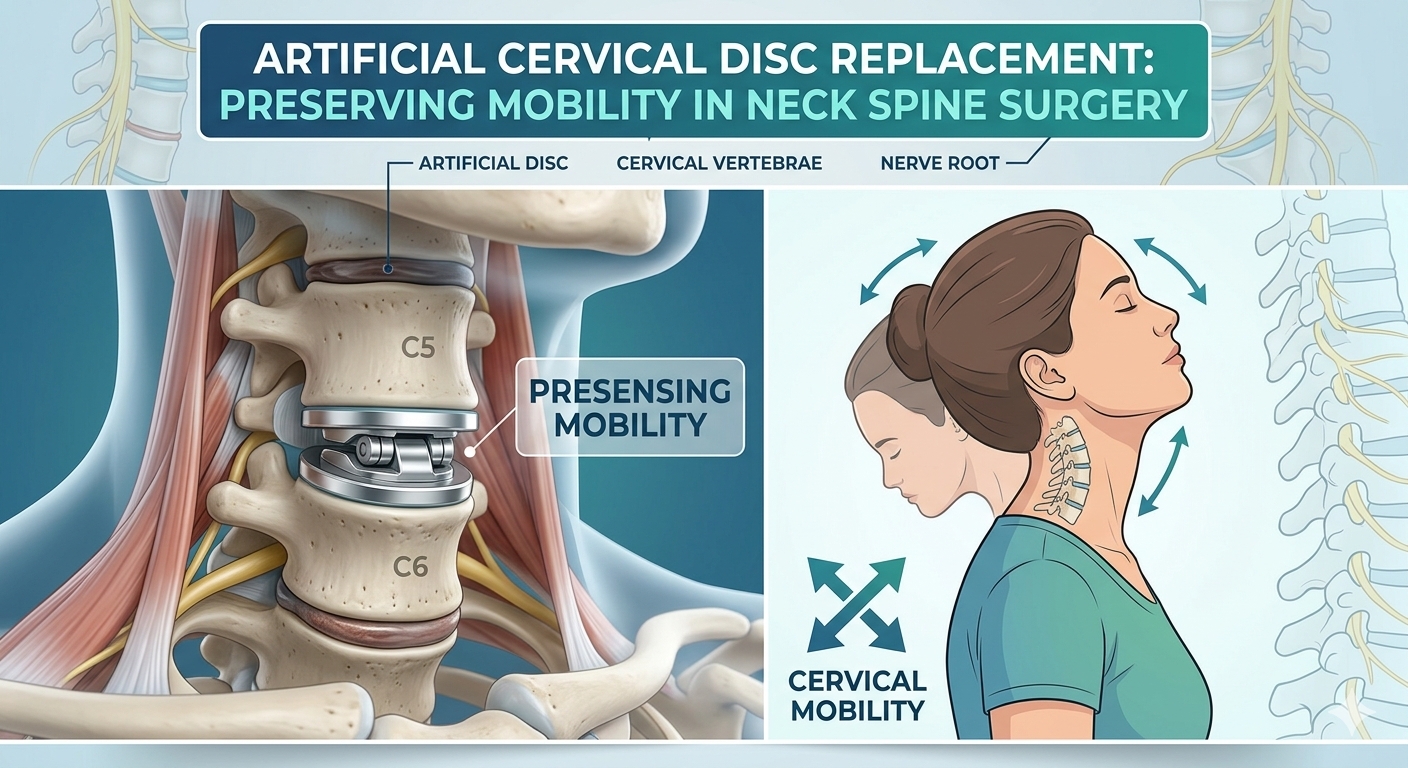
Artificial Cervical Disc Replacement: Preserving Mobility in Neck Spine Surgery
Artificial Cervical Disc Replacement: Preserving Mobility in Neck Spine Surgery
Neck pain accompanied by radiating numbness, tingling, or weakness down the arm is often caused by a herniated cervical disc or degenerative disc disease compressing a spinal nerve. For decades, the standard surgical treatment was Anterior Cervical Discectomy and Fusion (ACDF), which relieves nerve pressure by removing the damaged disc and fusing the adjacent vertebrae together.
While fusion remains highly effective, modern surgical advancements at Dr. Firas Husban Clinic offer an innovative alternative: Artificial Cervical Disc Replacement (Total Disc Replacement / Arthroplasty). This procedure is specifically engineered to relieve pain while preserving natural neck movement and protecting adjacent spinal segments.
What is Cervical Disc Replacement?
Artificial Cervical Disc Replacement is a motion-preserving surgical technique performed on the neck (cervical spine). After removing the diseased or herniated disc that is compressing the spinal cord or nerve roots, the surgeon replaces it with a medical-grade prosthetic implant (made of specialized metals and durable medical polymers).
Unlike spinal fusion—where bones are permanently joined together—the artificial motion-preserving disc acts as a mechanical joint, mimicking the natural height, flexibility, and biomechanics of a healthy human disc.
Key Advantages of Cervical Disc Replacement Over Spinal Fusion
Choosing artificial disc replacement offers several significant advantages for suitable patients:
- Preservation of Natural Neck Mobility: Maintains the natural range of motion (bending, turning, and rotating the neck).
- Protection of Adjacent Segments: Reduces biomechanical stress on neighboring discs, significantly lowering the risk of Adjacent Segment Disease (ASD) compared to traditional fusion.
- Faster Post-Operative Recovery: Eliminates the need to wait for bone fusion to heal, allowing patients to return to daily activities faster.
- No Bone Graft Required: Avoids the need for bone grafts or bone substitutes, reducing operative complexity and donor site discomfort.
- Minimal Post-Operative Immobilization: Patients rarely require rigid neck collars during the recovery period.
Target Audience Analysis: Is Cervical Disc Replacement Right for You?
Although Artificial Cervical Disc Replacement is a revolutionary option, it is tailored to specific clinical profiles and is not suitable for every cervical condition.
Ideal Candidates for Cervical Disc Replacement
This procedure provides optimal outcomes for individuals meeting the following criteria:
- Single-Level or Select Two-Level Cervical Disc Herniations: Patients with focal herniation or disc degeneration at one or two adjacent cervical levels (typically C3 to C7).
- Symptomatic Cervical Radiculopathy or Myelopathy: Persistent arm pain, numbness, weakness, or loss of hand coordination caused by nerve root or spinal cord compression.
- Failure of Non-Surgical Treatments: Patients who have undergone 6+ weeks of conservative therapy (physical therapy, medications, nerve blocks) without adequate relief.
- Preserved Cervical Motion & Good Bone Quality: Patients with adequate baseline neck flexibility, healthy bone density, and absence of advanced facet joint arthritis.
Non-Candidates / When Spinal Fusion Is Preferred
Disc replacement is contraindicated in conditions where joint stability or bone structural integrity is compromised:
- Severe Facet Joint Osteoarthritis: Significant arthritis in the posterior joints of the spine can cause persistent pain if motion is preserved.
- Spinal Instability or Severe Deformity: Conditions where vertebrae are hypermobile, misaligned, or severely deformed.
- Advanced Osteoporosis: Reduced bone mineral density increases the risk of implant subsidence or loosening.
- Significant Ossification of the Posterior Longitudinal Ligament (OPLL): Severe calcification that restricts mobility and requires broad decompression.
Overview of the Surgical Procedure
- Anterior Approach: A small horizontal incision is made along a natural skin crease on the front of the neck, minimizing visible scarring.
- Discectomy & Decompression: The damaged disc material and bone spurs pressing on the spinal nerve or cord are carefully removed under surgical magnification.
- Prosthetic Implantation: Under real-time X-ray guidance (Fluoroscopy), the artificial cervical disc is precisely sized and anchored into the disc space.
- Closure: The incision is closed in layers using cosmetic sutures.
Recovery and Post-Operative Expectations
- Hospital Stay: Most patients spend 24 hours or less in the hospital before discharge.
- Early Mobilization: Gentle neck motion is encouraged almost immediately after surgery; rigid neck braces are generally not required.
- Return to Work & Activities: Desk work and light routine activities can often be resumed within 1 to 2 weeks, with sports and full activities resuming as advised during follow-up visits.
Why Consult Dr. Firas Husban?
At Dr. Firas Husban Clinic, every patient receives a comprehensive clinical evaluation backed by advanced diagnostic imaging. As a specialist in complex and minimally invasive spine surgeries, Dr. Firas Husban ensures that treatment plans are strictly customized—choosing between motion-preserving disc replacement and spinal fusion based on what yields the safest, most durable, and pain-free long-term outcome.
To explore whether Artificial Cervical Disc Replacement is suitable for your condition, schedule a consultation at Dr. Firas Husban Clinic today.
Post Tags :
- artificial disc replacement
- cervical arthroplasty
- cervical disc replacement
- cervical herniated disc treatment
- cervical spine specialist
- disc replacement vs fusion
- Dr. Firas Husban
- motion preservation spine surgery
- neck pain surgery Jordan
- pinched nerve neck treatment
- استبدال ديسك الرقبة بالديسك الاصطناعي
- الحفاظ على حركة الرقبة
- الدكتور فراس الحسبان
- تثبيت الفقرات العنقية
- جراحة العمود الفقري طفيفة التوغل
- جراحة العمود الفقري في الأردن
- ديسك الرقبة الاصطناعي
- علاج انزلاق غضروفي عنقي
- علاج عصب الرقبة المضغوط
- عملية الديسك بالمنظار

