

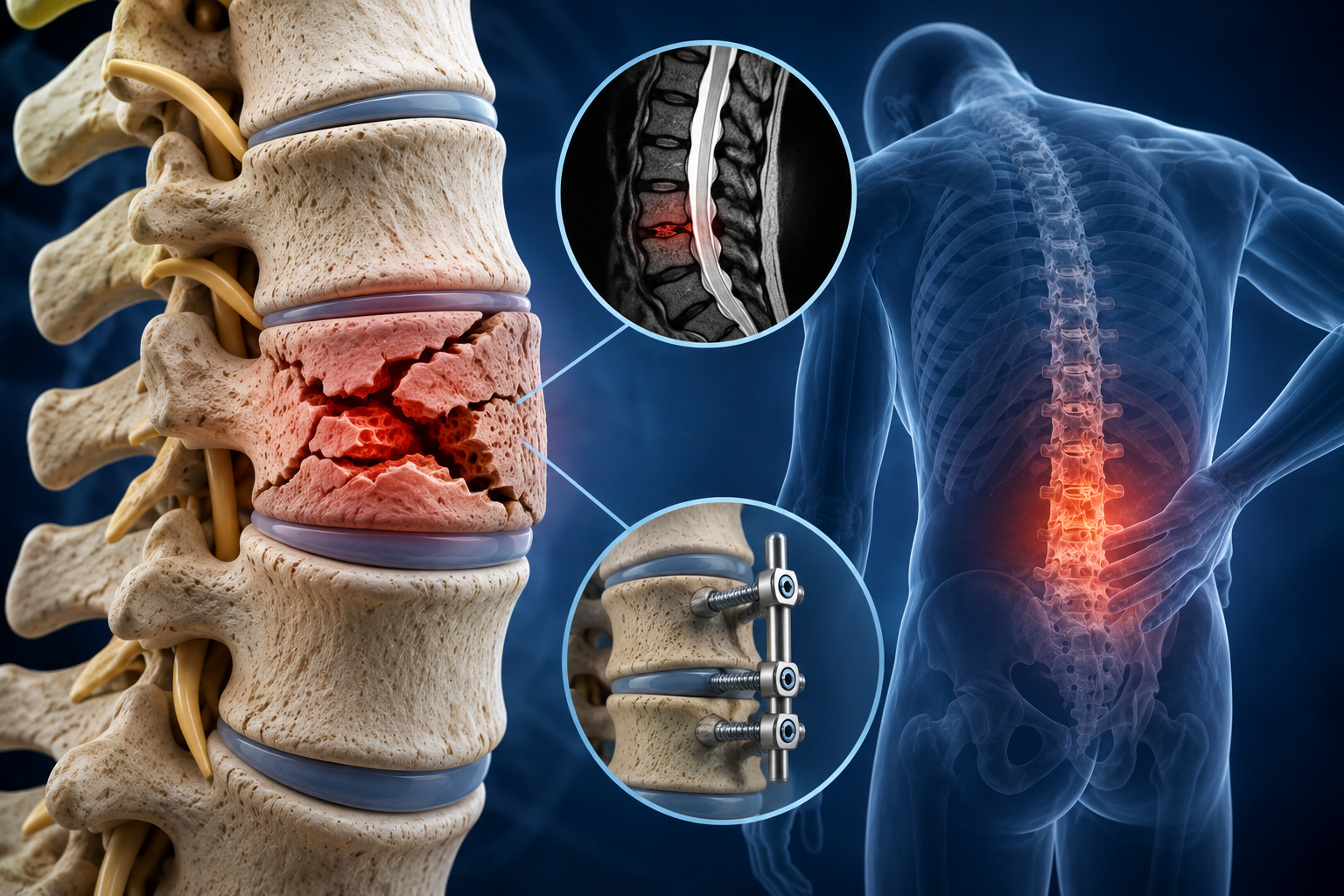
Spinal Fracture Treatment: Symptoms, Diagnosis, Surgery and Recovery
Spinal Fracture Treatment: Modern Approaches to Spine Stabilization and Recovery
What Is a Spinal Fracture?
A spinal fracture occurs when one or more of the vertebrae that make up the spinal column are damaged or broken.
Spinal fractures can range from relatively stable injuries that can be treated without surgery to complex fractures that compromise spinal stability or place pressure on the spinal cord and nerves.
The severity of a spinal fracture depends on factors such as the location of the injury, the type of fracture, the amount of vertebral damage, spinal alignment, and whether neurological structures are affected.
Dr. Firas Husban’s clinic provides spinal fracture treatment as part of its advanced spine surgery services and emphasizes minimally invasive and endoscopic techniques.
What Causes Spinal Fractures?
Spinal fractures can occur for several different reasons.
Accidents and Trauma
High-energy accidents, falls, sports injuries, and other traumatic events can cause fractures of the vertebrae.
Osteoporosis
Weakening of the bones can make the vertebrae more vulnerable to compression fractures, sometimes even after relatively minor trauma.
Age-Related Bone Weakness
Bone density can decrease with age, increasing the risk of vertebral fractures.
Tumors and Other Conditions
In some cases, diseases that weaken the vertebral bone can contribute to fractures.
Understanding the underlying cause is essential because treatment may differ significantly between a traumatic fracture and a fracture related to weakened bone.
Common Symptoms of a Spinal Fracture
Symptoms depend on the location and severity of the fracture.
Common symptoms may include:
- Sudden or severe back pain
- Pain that becomes worse when standing or walking
- Reduced spinal mobility
- Difficulty changing position
- Muscle spasms
- Changes in posture
- Height loss in certain compression fractures
Vertebral compression fractures can cause sudden back pain, limited spinal mobility, progressive height loss, and spinal deformity.
When Is a Spinal Fracture an Emergency?
Some spinal fractures require urgent medical evaluation.
Particular warning signs include:
- Severe back or neck pain after trauma
- Numbness or tingling
- New weakness in the arms or legs
- Difficulty walking
- Loss of sensation
- Loss of bladder or bowel control
- Significant neurological changes
Spinal trauma accompanied by neurological symptoms can indicate possible spinal cord or nerve involvement and requires urgent assessment.
How Are Spinal Fractures Diagnosed?
Accurate diagnosis is essential before deciding on treatment.
A spine specialist may use several diagnostic tools.
X-Ray
X-rays can provide information about vertebral alignment, bone structure, and certain types of fractures.
CT Scan
CT imaging provides detailed information about the bone and can help identify the exact characteristics of a fracture.
MRI
MRI can provide information about the spinal cord, nerve roots, discs, soft tissues, and other structures surrounding the spine.
MRI can be particularly useful when neurological symptoms are present or when additional information about the spinal cord and surrounding structures is needed.
Bone Density Testing
When osteoporosis is suspected, bone density testing may be recommended to evaluate bone strength and future fracture risk.
Does Every Spinal Fracture Require Surgery?
No.
The treatment of a spinal fracture depends on the type and severity of the injury.
Some stable fractures can be managed with:
- Pain management
- Activity modification
- Bracing
- Medical monitoring
- Treatment of underlying osteoporosis
- Physical rehabilitation
For certain vertebral compression fractures, minimally invasive procedures such as vertebroplasty or kyphoplasty may be considered when conservative treatment is not effective.
However, complex or unstable fractures may require surgical stabilization.
When Is Spinal Fracture Surgery Considered?
Surgery may be considered when the fracture results in significant instability, deformity, neurological compression, or other structural problems.
Potential reasons for surgical treatment can include:
- Spinal instability
- Significant vertebral collapse
- Progressive deformity
- Spinal cord compression
- Nerve compression
- Neurological deterioration
- Fractures that cannot be adequately managed conservatively
The decision must be individualized based on imaging, neurological examination, fracture characteristics, and the patient’s overall health.
Minimally Invasive Treatment of Spinal Fractures
Advances in spine surgery have made minimally invasive techniques available for selected spinal injuries.
Instead of requiring extensive exposure of the spine, minimally invasive approaches use smaller incisions and specialized instruments.
Potential benefits may include:
- Reduced tissue disruption
- Smaller incisions
- Reduced blood loss in selected procedures
- Less postoperative discomfort
- Earlier mobilization
- Potentially shorter recovery
However, not every fracture can or should be treated using a minimally invasive technique.
Complex injuries may require a more extensive surgical approach to achieve adequate stabilization and protect the spinal cord and nerves.
What Happens During Spinal Fracture Surgery?
The surgical technique depends on the type of fracture.
In some cases, the surgeon may stabilize the affected vertebrae using screws, rods, cages, bone grafts, or other spinal implants.
The objectives may include:
- Restoring spinal alignment
- Stabilizing the injured vertebrae
- Protecting the spinal cord and nerves
- Correcting deformity
- Reducing painful abnormal movement
- Supporting long-term spinal healing
The specific procedure is determined after reviewing the patient’s imaging and clinical condition.
Spinal Fractures and Spinal Stability
One of the most important considerations after a spinal fracture is whether the spine remains stable.
A stable fracture may sometimes heal without major surgery.
An unstable fracture, however, can place additional stress on the spinal structures and may require stabilization.
This is why treatment should not be based solely on the amount of pain.
Two patients can experience similar levels of pain while having very different fracture patterns and treatment requirements.
Spinal Fractures Related to Osteoporosis
Osteoporosis is an important cause of vertebral compression fractures.
When bones become weak, the vertebral body can partially collapse.
This may result in:
- Sudden back pain
- Reduced height
- Increased spinal curvature
- Difficulty standing upright
- Reduced mobility
Treatment should address both the fracture and the underlying bone weakness.
Preventing future fractures is an important part of long-term management.
Recovery After Spinal Fracture Treatment
Recovery depends on several factors.
These include:
- Type of fracture
- Location of the fracture
- Severity of the injury
- Whether surgery was required
- Neurological involvement
- Bone quality
- Age and overall health
- Rehabilitation progress
After treatment, patients may receive instructions regarding:
- Physical activity
- Lifting restrictions
- Medication
- Bracing
- Physical therapy
- Follow-up imaging
Following the treating surgeon’s instructions is essential for safe recovery.
Can a Spinal Fracture Affect the Spinal Cord?
Yes.
Some fractures can cause bone fragments or changes in spinal alignment that compromise the spinal canal.
If the spinal cord or nerve roots become compressed, neurological symptoms may develop.
These can include:
- Numbness
- Tingling
- Weakness
- Difficulty walking
- Loss of coordination
- Changes in bladder or bowel control
Spinal cord involvement can make a spinal fracture a medical emergency and requires immediate professional assessment.
Treating Complex Spinal Fractures
Complex spinal fractures require careful planning.
The surgeon may need to consider:
- Fracture pattern
- Spinal alignment
- Bone quality
- Neurological status
- Previous spinal operations
- Patient age
- Other medical conditions
In difficult cases, the objective is not simply to treat the fracture itself but to restore stability while protecting the spinal cord and surrounding nerves.
Spinal Fracture Treatment at Dr. Firas Husban
Dr. Firas Husban’s clinic lists spinal fracture treatment among its comprehensive spine services. The practice focuses on advanced spine surgery and minimally invasive or endoscopic techniques.
The clinic’s published patient cases also include complex fracture cases.
One documented case involves an 85-year-old patient from Iraq who underwent complex spinal surgery after suffering multiple spinal fractures. The clinic describes its spinal procedures as using minimally invasive or endoscopic techniques.
Another published case describes a patient who had suffered an L1 spinal fracture following an accident and later underwent treatment for the condition.
These cases demonstrate the importance of individualized assessment when dealing with complex spinal injuries.
How Can You Reduce the Risk of Spinal Fractures?
Not every spinal fracture can be prevented, particularly those caused by major trauma.
However, maintaining strong bones and reducing fall risk can help lower the risk of certain fractures.
Important measures include:
- Maintaining adequate physical activity
- Discussing bone health with your physician
- Evaluating osteoporosis when appropriate
- Maintaining muscle strength and balance
- Addressing fall hazards
- Following treatment for osteoporosis when prescribed
Bone health becomes particularly important for people who have already experienced a vertebral fracture.
When Should You See a Spine Specialist?
Seek professional evaluation if you experience persistent back pain after an injury or if imaging has revealed a spinal fracture.
You should seek urgent medical attention if back or neck pain is accompanied by:
- Weakness
- Numbness
- Loss of sensation
- Difficulty walking
- Bladder or bowel changes
- Severe neurological symptoms
Early assessment can help determine whether the fracture is stable and what treatment approach is appropriate.
Advanced Spine Care With Dr. Firas Husban
Spinal fractures can range from minor stable injuries to complex conditions requiring advanced surgical stabilization.
The most appropriate treatment depends on the fracture itself, spinal stability, neurological status, bone quality, and the patient’s overall health.
With modern imaging, minimally invasive techniques, and advanced spinal fixation procedures, selected patients may benefit from less invasive treatment approaches while still achieving the necessary spinal stabilization.
If you have experienced a spinal injury or have been diagnosed with a vertebral fracture, a comprehensive evaluation by an experienced spine specialist can help determine the safest path forward.
Post Tags :
- Dr. Firas Husban
- lumbar spine fracture
- minimally invasive spine surgery
- osteoporosis spinal fracture
- spinal cord compression fracture
- spinal fixation surgery
- spinal fracture recovery
- spinal fracture surgery
- spinal fracture surgery Jordan
- spinal fracture treatment
- spinal injury treatment
- spinal stabilization surgery
- spinal trauma treatment
- spine fracture specialist Jordan
- spine fracture treatment
- spine surgeon Amman
- thoracic spine fracture
- vertebral compression fracture
- vertebral fracture surgery
- vertebral fracture treatment
- أفضل دكتور عمود فقري في الأردن
- الدكتور فراس الحسبان
- تثبيت الفقرات بعد الكسور
- جراح العمود الفقري في الأردن
- جراحة العمود الفقري بالتدخل المحدود
- جراحة تثبيت العمود الفقري
- جراحة كسور الفقرات
- علاج إصابات العمود الفقري
- علاج الكسور الانضغاطية للفقرات
- علاج ضغط الحبل الشوكي
- علاج كسر الفقرة القطنية
- علاج كسور الظهر
- علاج كسور العمود الفقري
- علاج كسور العمود الفقري في الأردن
- علاج كسور الفقرات
- علاج كسور الفقرات الصدرية
- علاج كسور الفقرات القطنية
- علاج كسور الفقرات بسبب هشاشة العظام
- عملية كسر العمود الفقري
