
OLIF Spine Surgery: A Modern Minimally Invasive Treatment for Lower Back Problems
OLIF Spine Surgery: Advanced Minimally Invasive Spinal Fusion
What Is OLIF Spine Surgery?
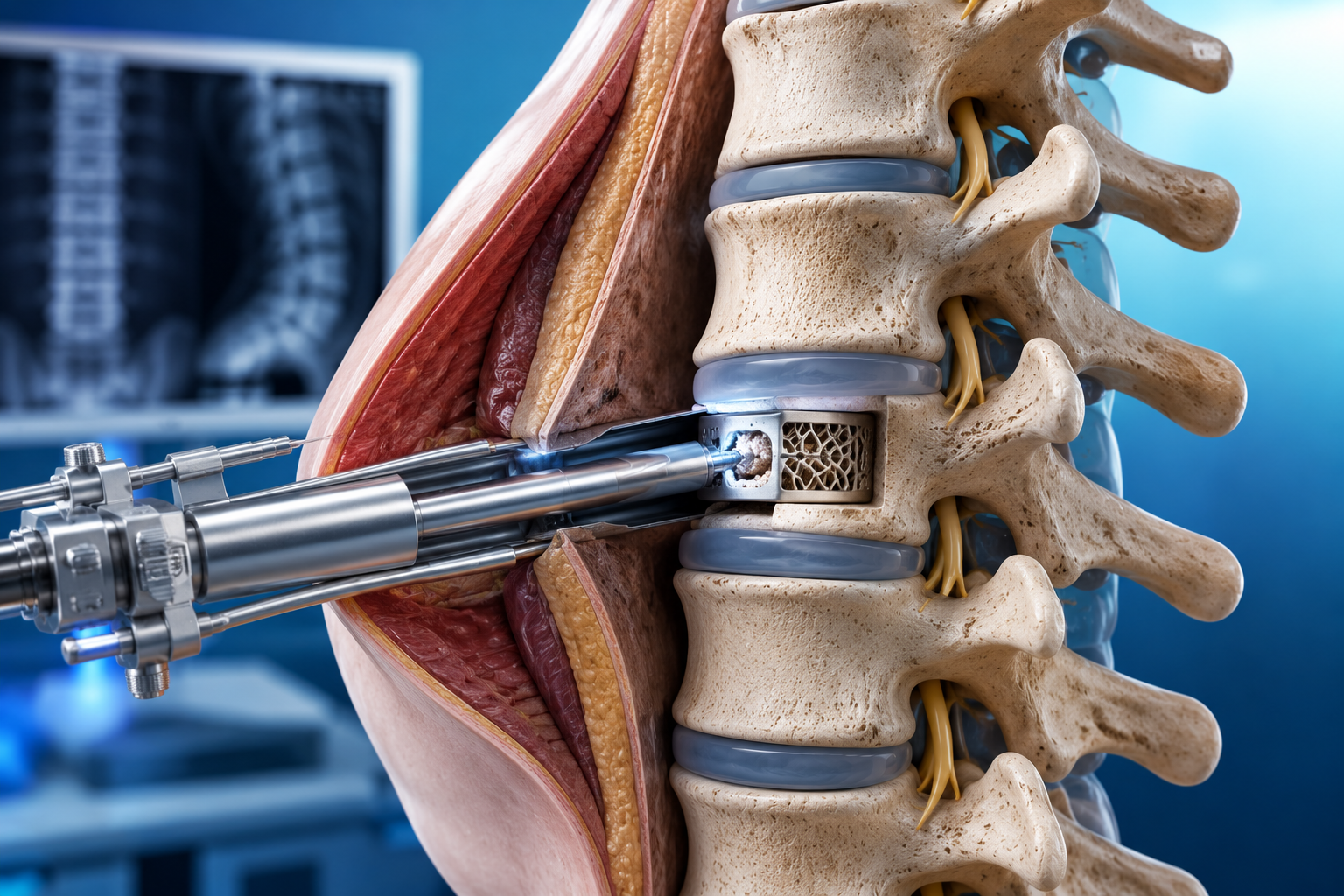
OLIF stands for Oblique Lumbar Interbody Fusion. It is a type of lumbar spinal fusion that uses an oblique approach to access the disc space from the side of the lumbar spine.
The goal of OLIF is to remove a damaged or degenerated disc and replace it with an implant or bone graft designed to restore disc height and help stabilize the affected spinal segment.
Over time, the treated vertebrae can fuse together, creating a more stable spinal segment.
OLIF is one of several modern approaches used in lumbar spinal fusion. The most appropriate technique depends on the patient’s diagnosis, spinal anatomy, previous surgeries, and overall condition.
Dr. Firas Husban’s clinic lists OLIF as one of its minimally invasive spine fixation procedures, alongside TLIF and DLIF.
What Conditions Can OLIF Treat?
OLIF may be considered for selected patients with structural problems affecting the lumbar spine.
Potential indications can include:
- Degenerative disc disease
- Spinal instability
- Certain types of spondylolisthesis
- Foraminal narrowing
- Certain spinal deformities
- Recurrent or persistent symptoms associated with spinal degeneration
- Some cases requiring revision or stabilization surgery
The decision to perform OLIF should always be based on a detailed medical evaluation and appropriate imaging.
Not every patient with lower back pain is a candidate for spinal fusion.
Understanding Degenerative Disc Disease
Between each vertebra in the spine is an intervertebral disc that acts as a cushion and helps absorb forces during movement.
Over time, discs can lose their normal structure and flexibility. This process may contribute to:
- Lower back pain
- Reduced mobility
- Disc-space narrowing
- Nerve compression
- Spinal instability
- Pain extending into the legs
When conservative treatments do not provide sufficient relief and a structural spinal problem is identified, surgical treatment may sometimes be considered.
Why Is OLIF Considered a Minimally Invasive Technique?
Traditional spinal procedures may require significant muscle exposure depending on the surgical approach.
OLIF uses an oblique access route to reach the lumbar disc space, potentially reducing the amount of posterior muscle disruption compared with some traditional posterior approaches.
Minimally invasive spinal surgery generally aims to accomplish the necessary surgical objective while limiting unnecessary disruption of surrounding tissues.
Potential benefits may include:
- Smaller incisions
- Less muscle disruption
- Reduced blood loss in selected procedures
- Less postoperative discomfort
- Earlier mobilization in appropriate patients
- Potentially faster recovery
However, minimally invasive surgery does not mean risk-free surgery, and the benefits vary according to the patient’s condition and the specific procedure.
How Is OLIF Performed?
The exact technique varies according to the patient’s anatomy and surgical plan.
Generally, the procedure involves several important stages.
1. Surgical Planning
Before surgery, the spine is carefully evaluated using clinical examination and appropriate imaging.
X-rays, CT scans, MRI, or other investigations may be used to understand the condition of the discs, vertebrae, nerves, and spinal alignment.
2. Accessing the Disc Space
The surgeon approaches the lumbar spine through an oblique corridor from the side of the body.
This approach is designed to provide access to the affected disc while minimizing disruption to posterior spinal muscles.
3. Removing the Damaged Disc
The damaged intervertebral disc is removed from the affected spinal level.
4. Restoring Disc Height
A specially selected implant or cage can be inserted into the disc space.
Restoring disc height may help improve the space available for affected neural structures and contribute to spinal alignment.
5. Spinal Stabilization
Depending on the patient’s condition, additional fixation using screws and other instrumentation may be used to stabilize the spinal segment.
6. Fusion
Bone graft material is used to encourage bone growth between the treated vertebrae.
The objective is for the vertebrae to eventually fuse into a stable spinal segment.
What Are the Potential Benefits of OLIF?
When appropriately selected, OLIF may offer several advantages.
Minimally Invasive Approach
The technique is designed to reduce unnecessary tissue disruption compared with some traditional approaches.
Spinal Stability
Fusion can stabilize a spinal segment affected by degeneration or instability.
Restoration of Disc Height
Replacing a collapsed disc can help restore the space between vertebrae.
Potential Nerve Decompression
In selected cases, restoring disc and foraminal height may help reduce pressure affecting nerve structures.
Reduced Muscle Disruption
Because the approach is different from traditional posterior surgery, it can reduce disruption of some of the muscles located behind the spine.
OLIF vs. Traditional Spine Surgery
There is no single spinal fusion technique that is best for every patient.
Different procedures—including OLIF, TLIF, DLIF and other fusion approaches—use different surgical corridors and have different indications.
A surgeon may choose one technique over another based on:
- The location of the spinal problem
- Number of affected levels
- Spinal alignment
- Previous spinal operations
- Bone quality
- Nerve compression
- Patient anatomy
- Overall medical condition
The objective is to select the safest and most appropriate procedure for the individual patient.
What Happens Before OLIF Surgery?
A thorough assessment is essential before considering spinal fusion.
The evaluation may include:
- Medical history
- Physical examination
- Neurological examination
- X-rays
- MRI
- CT imaging
- Assessment of spinal alignment
- Evaluation of previous surgeries
- General health assessment
The surgeon also evaluates whether non-surgical treatment has been attempted and whether fusion is appropriate for the underlying spinal condition.
What Is Recovery Like After OLIF?
Recovery varies considerably between patients.
Factors affecting recovery include:
- Number of spinal levels treated
- Surgical complexity
- Overall health
- Bone quality
- Previous spinal surgery
- Physical condition before surgery
- Individual healing response
Patients receive specific postoperative instructions regarding movement, lifting, medications, wound care, rehabilitation, and follow-up.
Although minimally invasive techniques can support earlier mobilization in appropriate patients, spinal fusion remains a significant surgical procedure and complete fusion can take substantially longer than the initial postoperative recovery period.
Are There Risks Associated With OLIF?
Like all spinal operations, OLIF carries potential risks.
Possible complications may include:
- Infection
- Bleeding
- Nerve injury
- Blood vessel injury
- Implant-related problems
- Failure of fusion
- Persistent or recurrent symptoms
- Adjacent spinal segment problems
- Risks related to anesthesia
The exact risks depend on the patient’s medical condition, anatomy, surgical technique, and complexity of the procedure.
A detailed discussion with the treating spine surgeon is essential before making a decision about surgery.
OLIF at Dr. Firas Husban
Dr. Firas Husban specializes in advanced spine surgery and minimally invasive techniques. His clinic specifically lists OLIF, TLIF and DLIF under its spine fixation services.
The clinic also features multiple patient cases involving OLIF procedures.
One documented case involves a patient who underwent minimally invasive OLIF surgery for a degenerative disc problem between the fourth and fifth lumbar vertebrae. The clinic describes this procedure as one of Dr. Firas Husban’s areas of expertise.
Another case documents OLIF stabilization surgery, demonstrating the use of this approach for lumbar spinal stabilization.
Who May Benefit From an OLIF Consultation?
A consultation with a spine specialist may be appropriate if you have:
- Persistent lower back pain
- Back pain associated with leg symptoms
- Degenerative disc disease
- Spinal instability
- Symptoms that have not improved with conservative treatment
- A history of previous spinal surgery
- Imaging showing significant degenerative spinal changes
A consultation does not automatically mean surgery.
The purpose is to determine the actual cause of symptoms and identify the most appropriate treatment.
Choosing the Right Spine Treatment
Modern spine surgery offers several approaches, but technology alone does not determine the right treatment.
The most important step is accurate diagnosis.
A comprehensive evaluation can determine whether the patient needs:
- Medication
- Physical therapy
- Injections
- Observation
- Minimally invasive decompression
- Spinal fusion
- Another specialized treatment
The goal should always be to choose the least invasive treatment that can appropriately address the patient’s specific spinal problem.
Schedule a Spine Consultation
If persistent lower back pain or spinal degeneration is affecting your daily life, an accurate diagnosis is the first step toward finding an appropriate treatment.
Dr. Firas Husban provides advanced spinal evaluation and minimally invasive spine surgery options, including OLIF, TLIF and DLIF.
A personalized consultation can help determine whether OLIF or another treatment approach is appropriate for your condition.
Post Tags :
- degenerative disc disease treatment
- Dr Firas Husban spine surgery
- Dr. Firas Husban
- lower back pain treatment
- lumbar disc degeneration
- lumbar fusion surgery
- lumbar spinal fusion
- minimally invasive lumbar fusion
- minimally invasive spine surgeon
- minimally invasive spine surgery
- oblique lumbar interbody fusion
- OLIF Jordan
- OLIF procedure
- OLIF spine surgery
- OLIF surgery
- OLIF surgery Jordan
- spinal instability treatment
- spine fixation surgery
- spine specialist Amman
- spine surgeon Jordan
- أفضل جراح عمود فقري في الأردن
- استشاري جراحة العمود الفقري
- الدكتور فراس الحسبان
- تثبيت الفقرات القطنية
- جراحة OLIF
- جراحة العمود الفقري الحديثة
- جراحة العمود الفقري بالتدخل المحدود
- جراحة العمود الفقري في الأردن
- جراحة دمج الفقرات
- دمج الفقرات القطنية المائل
- علاج ألم أسفل الظهر
- علاج تآكل الغضاريف
- علاج تآكل فقرات الظهر
- علاج عدم استقرار العمود الفقري
- علاج مشاكل الفقرات القطنية
- عملية OLIF
- عملية OLIF في الأردن
- عملية تثبيت العمود الفقري
- عملية دمج الفقرات القطنية
