
Cervical Spine Fusion Surgery: Causes, Symptoms, Treatment and Recovery
Cervical Spine Fusion Surgery: Advanced Treatment for Neck and Spinal Problems
Understanding the Cervical Spine
The cervical spine is the upper portion of the spinal column and consists of seven vertebrae that support the head while allowing the neck to move and rotate. It also protects the spinal cord, which carries important nerve signals between the brain and the rest of the body.
Because the cervical spine is responsible for both movement and protection of the spinal cord, problems in this area can sometimes cause symptoms that extend beyond the neck itself.
Cervical spine conditions may lead to neck pain, pain extending into the shoulders or arms, numbness, weakness, reduced hand coordination, and problems with balance or walking. These symptoms can occur when nerves or the spinal cord become compressed.
What Is Cervical Spine Fusion?
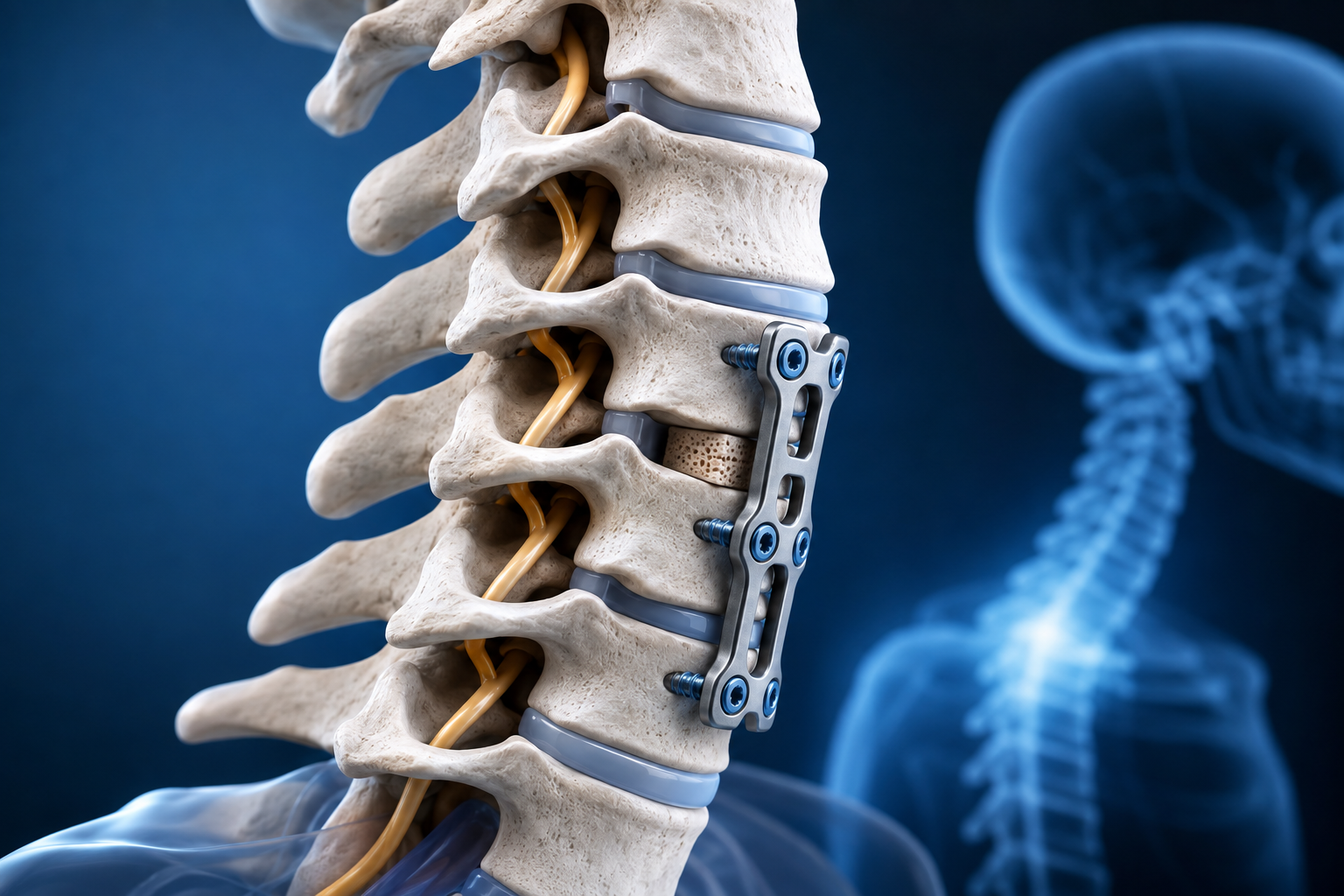
Cervical spine fusion is a surgical procedure designed to stabilize two or more vertebrae by creating a solid connection between them.
The procedure may be considered when a cervical spine problem causes significant instability, nerve or spinal cord compression, deformity, or persistent symptoms that have not responded adequately to conservative treatment.
The main objectives of cervical spine surgery are to relieve pressure on the spinal cord or nerves, maintain or restore spinal stability, and preserve or correct spinal alignment.
Dr. Firas Husban’s clinic includes cervical spine fusion among its advanced spine surgery services and specializes in minimally invasive approaches and endoscopic techniques.
When Might Cervical Spine Fusion Be Recommended?
Not every patient with neck pain requires surgery.
In many cases, symptoms can initially be managed with conservative treatments such as medication, physical therapy, activity modification, and other non-surgical approaches.
Surgery may become an option when symptoms persist or when there are neurological problems or structural abnormalities that require surgical treatment.
Potential reasons for cervical spine surgery may include:
- Persistent neck pain associated with an identifiable spinal condition
- Cervical disc degeneration
- Herniated cervical discs causing nerve compression
- Narrowing of the spinal canal
- Compression of the spinal cord
- Progressive weakness or numbness
- Problems with balance or walking
- Cervical spinal instability
- Certain spinal deformities
- Traumatic cervical spine injuries
The decision to perform a fusion depends on the specific diagnosis, imaging findings, neurological examination, overall health, and the patient’s individual circumstances.
Cervical Nerve Compression and Its Symptoms
One of the reasons cervical spine problems can become particularly disruptive is that compressed nerves can produce symptoms away from the neck.
A patient may experience:
Neck Pain
Pain can be localized around the cervical spine and may become worse with certain movements.
Arm Pain
Pain caused by nerve compression can travel from the neck into the shoulder, arm, or hand.
Numbness and Tingling
Patients may experience pins and needles or reduced sensation in the arm, hand, or fingers.
Muscle Weakness
Nerve compression can sometimes cause weakness in the upper extremities.
Reduced Hand Coordination
Some cervical spinal conditions can affect fine motor skills, making everyday tasks more difficult.
Balance and Walking Problems
When the spinal cord is affected, patients may experience an unsteady gait or difficulty maintaining balance.
Progressive weakness, numbness, or significant balance and walking problems should be evaluated promptly by an appropriate spine specialist.
What Causes Problems in the Cervical Spine?
Several conditions can affect the cervical spine and potentially lead to nerve or spinal cord compression.
Cervical Disc Degeneration
The discs between the vertebrae can gradually change with age and wear. Loss of disc height and degenerative changes can contribute to nerve compression and spinal instability.
Herniated Cervical Disc
A damaged disc may protrude into the spinal canal and place pressure on a nerve root or the spinal cord.
Cervical Spinal Stenosis
The spinal canal may become narrower, leaving less space for the spinal cord and nerves.
Bone Spurs
Degenerative changes may result in abnormal bone growth that contributes to narrowing around nerves or the spinal cord.
Spinal Instability
Abnormal movement between vertebrae can affect spinal alignment and may require stabilization.
Trauma
Certain cervical spine injuries can damage the vertebrae, discs, or supporting structures and may require surgical stabilization.
How Is Cervical Spine Disease Diagnosed?
A successful treatment plan starts with an accurate diagnosis.
During a consultation, the spine specialist evaluates the patient’s symptoms, medical history, physical condition, and neurological function.
Imaging may also be necessary to understand the condition of the cervical spine.
Depending on the case, diagnostic evaluation may include:
- X-rays
- Magnetic resonance imaging (MRI)
- Computed tomography (CT)
- Neurological examination
- Evaluation of spinal alignment and stability
Imaging findings should always be interpreted together with the patient’s symptoms and clinical examination. Degenerative changes on an image do not necessarily mean that surgery is required.
What Happens During Cervical Spine Fusion Surgery?
The exact surgical technique depends on the location and cause of the spinal problem.
In some procedures, the surgeon approaches the cervical spine from the front of the neck. This may allow access to a damaged disc or other structure compressing the nerves or spinal cord.
The problematic disc or compressive material may be removed to decompress the neural structures. The space between the vertebrae can then be reconstructed using an appropriate implant or bone graft, allowing the vertebrae to eventually fuse.
In other cases, a posterior approach may be more appropriate.
The surgical strategy is therefore not identical for every patient. The surgeon selects the approach based on the patient’s anatomy, diagnosis, number of affected levels, spinal alignment, neurological findings, and other factors.
Minimally Invasive Cervical Spine Surgery
Modern spine surgery increasingly focuses on achieving the necessary surgical goals while minimizing unnecessary tissue disruption.
Dr. Firas Husban’s practice emphasizes minimally invasive and endoscopic techniques across its procedures.
Depending on the specific procedure, minimally invasive approaches may offer advantages such as:
- Smaller surgical incisions
- Reduced disruption of surrounding tissues
- Potentially less postoperative discomfort
- Reduced blood loss in appropriate procedures
- Faster mobilization in selected patients
- A potentially shorter recovery period
However, the suitability of minimally invasive surgery depends entirely on the patient’s condition. A minimally invasive approach is not automatically the best option for every cervical spine problem.
What Are the Main Goals of Cervical Fusion Surgery?
Cervical fusion is not performed simply to treat neck pain.
The procedure may have several important objectives depending on the patient’s diagnosis.
These can include:
Decompression
Removing pressure from the spinal cord or nerve roots.
Stabilization
Creating a stable connection between affected vertebrae.
Alignment
Maintaining or correcting the appropriate position of the cervical spine.
Neurological Protection
In selected cases involving spinal cord or nerve compression, surgery may be performed to prevent further neurological deterioration.
Pain Relief
When pain is caused by a structural spinal problem that is appropriate for surgical treatment, relieving the underlying compression or instability may help reduce symptoms.
The expected outcome depends on the underlying condition, severity, duration of symptoms, and individual patient factors.
What Is Recovery Like After Cervical Spine Fusion?
Recovery is different for every patient.
The length of recovery depends on factors such as:
- The number of spinal levels treated
- The surgical technique used
- The patient’s overall health
- The severity of the original condition
- Whether nerve or spinal cord compression was present
- The patient’s response to rehabilitation
After surgery, patients receive specific instructions regarding activity, medication, wound care, follow-up appointments, and rehabilitation.
The treating surgeon determines when activities such as driving, work, exercise, and other normal activities can safely be resumed.
What Are the Risks of Cervical Spine Fusion?
Like any surgical procedure, cervical spine surgery carries potential risks.
Possible complications can include:
- Infection
- Persistent or recurrent pain
- Inadequate symptom improvement
- Nerve or spinal cord injury
- Failure of the vertebrae to fuse
- Implant-related complications
- Spinal instability
- Swallowing or voice-related problems in some anterior approaches
- Cerebrospinal fluid leakage
- Blood vessel or other surrounding-structure injury
The actual risks vary according to the procedure, surgical approach, patient’s health, and complexity of the spinal condition.
For this reason, the decision to undergo cervical spine fusion should be made after a detailed medical evaluation and discussion between the patient and spine surgeon.
Cervical Spine Fusion at Dr. Firas Husban
Dr. Firas Husban is a Consultant Orthopedic Surgeon specializing in spine surgery, with more than 28 years of experience in treating complex spinal conditions. His practice focuses on minimally invasive spine surgery, spinal deformities, corrective procedures, and other advanced spinal treatments.
The clinic’s listed spine services include cervical spine fusion, spinal fixation procedures such as OLIF, TLIF, and DLIF, revision surgery, fracture treatment, scoliosis and kyphosis treatment, and minimally invasive disc procedures.
The clinic also documents cases involving minimally invasive cervical fixation. One published case describes a patient with cervical spinal canal stenosis associated with neurological symptoms including balance difficulties and impaired control of the limbs.
Why a Personalized Treatment Plan Matters
Cervical spine problems can look similar on the surface while requiring completely different treatments.
For example, two patients may both complain of neck pain, but one may have a cervical disc problem while another may have spinal canal narrowing or spinal cord compression.
This is why treatment should not be based on symptoms alone.
A comprehensive evaluation helps determine:
- The exact source of symptoms
- Whether nerves or the spinal cord are compressed
- Whether the spine is stable
- Which spinal levels are affected
- Whether non-surgical treatment may be appropriate
- Whether surgery is necessary
- Which surgical approach is most suitable
The goal is not simply to perform surgery. The goal is to identify the most appropriate treatment for the patient’s specific condition.
When Should You See a Spine Specialist?
You should consider a professional evaluation if neck symptoms are persistent, worsening, or associated with neurological changes.
Particularly important symptoms include:
- Progressive arm or leg weakness
- Persistent numbness or tingling
- Difficulty walking
- Loss of balance
- Reduced hand coordination
- Severe pain that does not improve with conservative treatment
- Neck symptoms following significant trauma
Sudden neurological weakness or serious symptoms following trauma require urgent medical assessment.
Take the First Step Toward Better Spine Health
Persistent neck pain should not always be dismissed as a normal part of aging.
When symptoms are caused by cervical disc disease, spinal stenosis, nerve compression, spinal cord compression, or instability, an accurate diagnosis can help determine whether conservative treatment or surgery is appropriate.
With advanced diagnostic methods and modern minimally invasive spine surgery techniques, patients can receive a treatment plan tailored to their individual condition.
If you are experiencing persistent neck pain, arm symptoms, weakness, numbness, or balance difficulties, schedule a consultation with Dr. Firas Husban for a comprehensive evaluation of your cervical spine.
Medical Disclaimer: This article is intended for general educational purposes and does not replace an examination or individualized medical advice from a qualified physician. The appropriate treatment depends on each patient’s specific diagnosis and clinical condition.
Post Tags :
- cervical decompression surgery
- cervical disc degeneration
- cervical disc herniation treatment
- cervical disc surgery
- cervical fusion Jordan
- cervical fusion surgery
- cervical myelopathy treatment
- cervical nerve compression
- cervical spinal stenosis treatment
- cervical spine fusion
- cervical spine surgeon Jordan
- cervical spine surgery
- cervical spine surgery Jordan
- cervical spine treatment Jordan
- Dr. Firas Husban
- minimally invasive cervical spine surgery
- neck pain treatment
- spinal cord compression treatment
- spine specialist Jordan
- spine surgeon Amman
- أفضل دكتور عمود فقري في الأردن
- الدكتور فراس الحسبان
- تثبيت الفقرات العنقية
- جراح العمود الفقري في عمان
- جراحة العمود الفقري العنقي
- جراحة العمود الفقري بالتدخل المحدود
- جراحة الفقرات العنقية في الأردن
- جراحة تثبيت فقرات الرقبة
- جراحة ديسك الرقبة
- علاج ألم الرقبة
- علاج اعتلال النخاع العنقي
- علاج انزلاق غضروف الرقبة
- علاج تضيق القناة الشوكية العنقية
- علاج تنميل اليدين بسبب الرقبة
- علاج ديسك الرقبة
- علاج ضعف الأطراف بسبب العمود الفقري
- علاج ضغط الأعصاب في الرقبة
- علاج ضغط الحبل الشوكي
- علاج مشاكل فقرات الرقبة
- عملية تثبيت الفقرات العنقية
